

Manifestation Techniques, Mindset & Journaling, Mood & Habit Tracking, Rituals, Routines & Intentional Living, Tool Tips & Tutorials
Mood Tracking: 7 Powerful Reasons It Makes Your Manifestation Practice More Real
Jun
Manifestation isn’t just about what you write or visualize. It’s also about how you feel while doing it. That’s where mood tracking comes in.
Mood tracking is the simple act of noticing how you feel and writing it down. It might not sound like much, but it can completely change the way you approach your practice.
You don’t need charts or color codes. You don’t need to rate yourself on a complicated scale. You just need to ask one honest question: “How am I feeling right now?”
This article explains why mood tracking matters, how it supports manifestation, and how to use it without turning it into another to-do.
Why Mood Tracking Helps Manifestation
Manifestation is not just about setting goals. It’s about showing up for yourself and learning how you respond to life as it unfolds.
Mood tracking gives you something most people skip: awareness.
When you pay attention to how you feel, you can:
- Choose techniques that match your energy
- Notice patterns over time
- Catch resistance early
- Celebrate progress even when the results aren’t visible yet
Mood tracking grounds your manifestation work in your real emotional experience. That makes it feel more honest, more helpful, and more likely to stick.
Research supports the idea that mood tracking promotes emotional clarity and improves long-term self-regulation. A 2024 IEEE paper emphasized that combining mood logs, mindfulness, and personalized insights gave users clear feedback about their emotional state. This helped them make better decisions and build healthier routines over time.
1. Mood Tracking Builds Self-Awareness
It’s easy to go through the motions with your manifestation practice. You write your 3-6-9s. You visualize. You say an affirmation.
But how do you feel while doing it?
Mood tracking brings that question to the front. It helps you notice when something’s off, or when something is working better than you thought.
Example:
- You might realize that scripting feels great in the morning but flat at night.
- Or that certain affirmations feel more true when you’re calm and rested.
That kind of self-awareness gives you the power to adjust instead of forcing things.
2. It Helps You Choose the Right Technique
Not every technique works the same way every day.
Some days you might need structure. Other days you might need softness. Mood tracking helps you pick what fits your energy instead of just repeating a routine out of habit.
Examples:
- If you’re feeling anxious, gratitude journaling might help you slow down.
- If you’re excited and focused, scripting might feel easy.
- If you’re frustrated, a quick affirmation might feel more realistic than trying to visualize a perfect outcome.
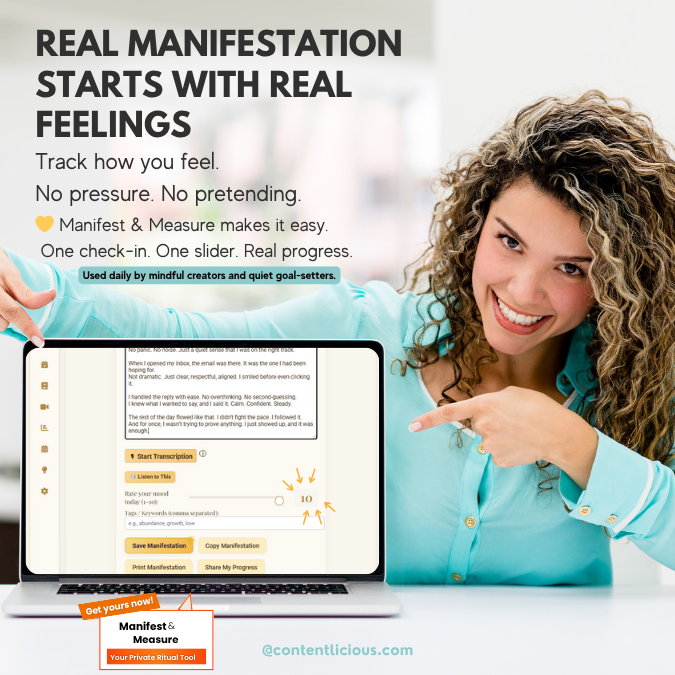
Inside Manifest & Measure, you can track your mood right next to any entry. That gives you instant feedback on what works best for you.
3. Mood Tracking Shows You Patterns Over Time
One entry doesn’t tell you much. But after a few days or weeks, mood tracking becomes a powerful mirror.
You start to see:
- When your energy tends to dip
- Which days you feel most motivated
- What kind of intentions match your better moods
This helps you understand your rhythm. And once you know your rhythm, you can plan better. You stop pushing against yourself and start moving with your natural flow.
That’s how consistency gets easier. Not by forcing it, but by knowing what supports it.
4. Mood Tracking Makes the Practice More Honest
Sometimes manifestation content creates pressure to feel good all the time. But that’s not real life.
You’ll have days when you feel off, tired, angry, or flat. That’s normal. The key is to include those days, not ignore them.
Mood tracking lets you do that in a small, manageable way.
When you check in honestly, you don’t have to pretend. You just acknowledge what’s true for you today.
This keeps your practice grounded. It makes it easier to trust yourself and stay with it long-term.
5. It Makes Progress Visible
Progress isn’t always about external results. Sometimes the biggest wins are emotional.
It helps you notice:
- A shorter recovery time after a rough day
- More calm in situations that used to stress you out
- A clearer sense of what matters
You might not see a big change in your outer world right away. But mood tracking shows you how your inner world is shifting. That builds confidence and momentum.
In Manifest & Measure, your mood data gets saved with your entries. You can scroll back and see how you felt on different days, across different techniques. That kind of insight is hard to get any other way.
6. Mood Tracking Is Quick and Flexible
You don’t need to overcomplicate it.
Here’s a simple version:
- Choose a word: calm, tense, focused, flat
- Or pick a number from 1 to 5
- Or use a slider like the one inside the tool
The point is to check in. Not to grade yourself. Not to fix anything.
Just ask, “How do I feel right now?” and let the answer be enough.
7. Mood Tracking Helps You Reconnect
Some days, manifestation practice feels off. You might not want to write or visualize. That’s okay.
Mood tracking can help you reconnect by offering a low-effort way to stay engaged.
Even if you don’t write much, even if you skip scripting or affirmations, you can still check in with how you feel. That one small action reminds you that you’re still showing up.
Over time, these check-ins become anchors. They give your practice structure without pressure.
Common Myths About Mood Tracking
Let’s clear a few things up.
Myth 1: “I need to feel good for this to count.”
Truth: Your mood doesn’t have to be high. It just has to be real.
Myth 2: “If I feel bad, I’m manifesting bad things.”
Truth: Your emotions don’t cancel your efforts. They’re just signals. Learn from them.
Myth 3: “I don’t want to focus on the negative.”
Truth: Noticing how you feel isn’t the same as dwelling on it. It’s awareness, not rumination.
Mood tracking is not about judging your emotions. It’s about witnessing them and making space for honesty.
How to Add Mood Tracking to Your Practice
You can add mood tracking at the start or end of any technique. Here’s how it might look:
- Before scripting: check your mood first. Let it guide your tone.
- After affirmations: ask yourself if it changed anything.
- At the end of the day: track how the full day felt, not just the moment.
In Manifest & Measure, every technique lets you track mood right inside the entry. That means you don’t need a separate app or journal. Just a few seconds and your own words.
Final Thoughts
Mood tracking is not a gimmick. It’s not extra. It’s one of the most real parts of your manifestation practice.
It gives you the space to tell the truth about how you’re feeling. That makes everything else – affirmations, scripting, gratitude – more grounded.
You don’t need to feel good all the time. You just need to stay connected.
That’s what mood tracking helps with. It’s a way to stay honest with yourself while you grow.
And if you want a place to do it without noise, pressure, or comparison, Manifest & Measure is ready for you.
One mood check at a time.